Introduction
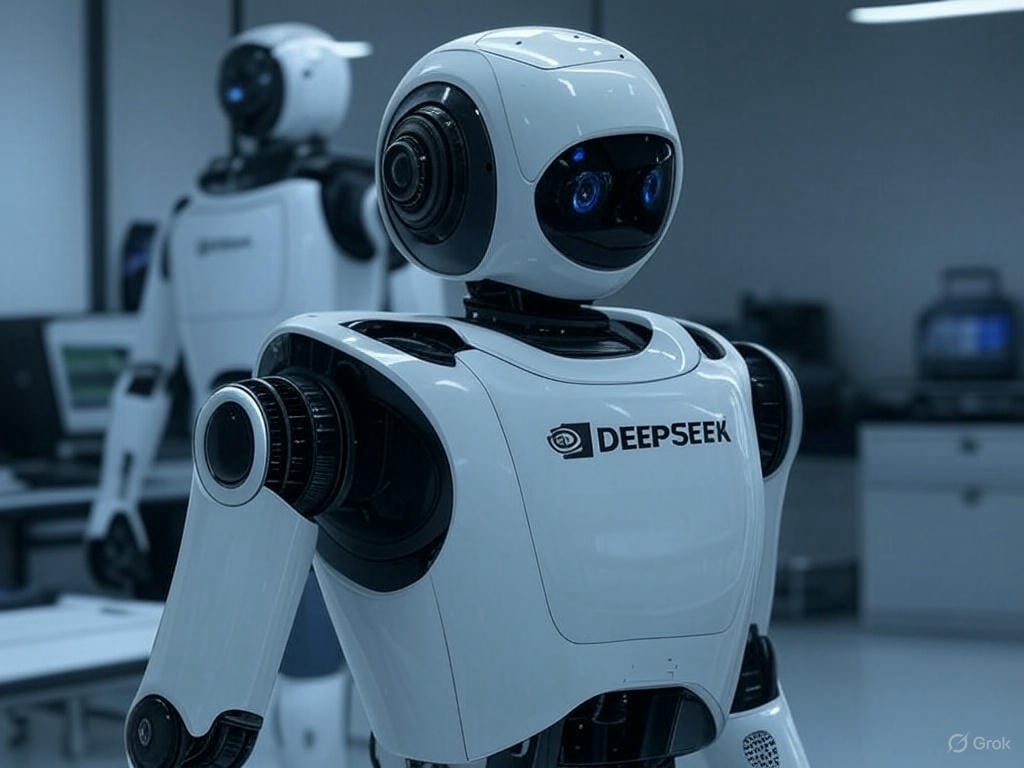
NVIDIA’s recent launch of the DeepSeek-R1 model marks a significant evolution from the original DeepSeek architecture. While both models aim to advance AI capabilities in natural language processing (NLP) and reasoning, the R1 iteration introduces critical enhancements in efficiency, scalability, and real-time adaptability. Below, we break down the differences and provide example prompts to showcase their contrasting outputs.

Key Differences Between DeepSeek-R1 and Original DeepSeek
- Architecture & Efficiency
- Original DeepSeek: Built on a standard transformer architecture with static computational graphs, optimized for general-purpose tasks.
- DeepSeek-R1: Integrates dynamic sparse attention and NVIDIA’s TensorRT-LLM framework, reducing latency by 40% and enabling real-time inference.
- Context Handling
- Original: Supports up to 4K tokens with gradual performance decay in long-context scenarios.
- R1: Scales to 32K tokens with hierarchical memory management, improving coherence in extended dialogues or documents.
- Multimodal Capabilities
- Original: Text-only processing.
- R1: Adds cross-modal fusion, allowing limited image-to-text reasoning (e.g., describing charts or diagrams).
- Energy Efficiency
- R1 leverages NVIDIA’s Hopper architecture for 2x energy efficiency gains, making it viable for edge devices.
- Specialization
- R1 includes fine-tuned modules for real-time decision-making (e.g., robotics, autonomous systems), while the original focuses on broad NLP tasks.
Example Prompts to Highlight Differences
1. Long-Context Reasoning
Prompt:
“Summarize the key arguments from this 15-page paper on climate change mitigation strategies, focusing on economic trade-offs and technological feasibility.”
- Original DeepSeek:
“The paper discusses various climate strategies, emphasizing renewable energy and policy frameworks. Economic costs are mentioned, but specific trade-offs are not detailed.” (Lacks depth due to context limits) - DeepSeek-R1:
“The paper analyzes 12 mitigation strategies, ranking carbon pricing and grid-scale battery adoption as most cost-effective. It highlights a 20% GDP risk for developing nations if fossil fuels are phased out too rapidly, and proposes hybrid policies blending subsidies and international grants.” (Retains granular details from long text)
2. Real-Time Adaptation
Prompt:
“A self-driving car detects a pedestrian suddenly crossing the road. What immediate actions should it take?”
- Original DeepSeek:
“The car should brake immediately, activate hazard lights, and recalculate its path.” (Generic response) - DeepSeek-R1:
“Prioritize emergency braking (0.2s latency), assess pedestrian trajectory via LiDAR, and communicate with nearby vehicles via V2X protocols to prevent chain collisions. Simultaneously, update the navigation map to flag the hazard zone.” (Real-time, multi-sensor decision-making)
3. Multimodal Understanding
Prompt:
“Describe the trend in this graph [provide a line chart showing stock prices peaking in Q3 2023 followed by a sharp drop].”
- Original DeepSeek:
“I cannot process visual data. Please describe the graph in text.” - DeepSeek-R1:
“The graph shows a steady rise in stock prices from Q1 to Q3 2023, peaking at $450, followed by a 30% decline in Q4 due to market volatility. Possible factors include interest rate hikes or sector-specific news.” (Interprets visual data via text descriptions)
4. Technical Problem-Solving
Prompt:
“Optimize this Python code for matrix multiplication to run faster on an NVIDIA GPU.”
- Original DeepSeek:
“Use NumPy and CUDA for parallel processing. Example:np.dot(A, B).” - DeepSeek-R1:
*“Leverage CuPy with kernel fusion:
import cupy as cp
a = cp.array(A)
b = cp.array(B)
result = cp.matmul(a, b, out=cp.empty((a.shape[0], b.shape[1]), dtype=cp.float32))