On April 13, 2025, I had the privilege of delivering a keynote speech at a community event in Dubai, where I introduced a powerful idea: Jammu will meet Jerusalem in Jeddah. This phrase, which I first remarked at the beginning of my speech, is not just a symbolic statement but a bold vision for a complete reversal of a thousand years of history in the Gulf region. It’s a vision that credits one man—India’s Prime Minister—for spearheading this monumental shift.
Understanding the Vision: Jammu, Jerusalem, and Jeddah
For those unfamiliar with the concept, let me break it down. When I say Jammu meets Jerusalem in Jeddah, I’m referring to a profound historical and cultural reconnection. The world, as I explained, can be broadly divided into two belts: the Jammu belt and the Jerusalem belt. The Jammu belt, encompassing the Ganga and Indus rivers, gave rise to four Dharmic traditions. The Jerusalem belt birthed two Abrahamic religions—Christianity and Judaism. Later, in Saudi Arabia, a blend of Abrahamic commandments and desert practices led to the codification of Islam.
Jeddah, a historic commercial hub and sacred city in Saudi Arabia, serves as the meeting point in this vision. Historically, worship items traveled from India through Saudi Arabia to Israel’s Temple Mount. If you look at a map (as I shared on my X handle one and a half years ago), you’ll notice an astonishing alignment: Gujarat’s Somnath temple and Saudi Arabia’s Kaaba lie on the same line and length, as do Kedarnath and Israel’s Temple Mount. This ancient connection underscores the deep ties between these regions, long before the disruptions of history.
A Thousand-Year Reversal: What Does It Mean?
When I speak of a thousand-year reversal, I’m addressing two distinct historical shifts:
- A 400-year reversal of British colonialism, which altered global trade and cultural dynamics.
- A 1000-year reversal dating back to the Islamic invasions, which led to forced conversions in various regions.
To achieve this reversal, we must revive the ancient trade routes that once connected India, Saudi Arabia, and beyond. For centuries, ports along Gujarat, Mumbai, Maharashtra, Kerala, the western Ghats, eastern Africa, and the Gulf were linked in a thriving trade network—long before Islam emerged. Reviving these ties requires unearthing the pre-Islamic history of the Gulf, particularly the Chandravanshi-Bharatiya roots of Saudi Arabia and the UAE.
The Role of National Archives and Historical Proof
During my speech, I highlighted the recent MOUs between India, Saudi Arabia, and the UAE, which enable the exchange and access to National Archives. This is a crucial step. The Gulf nations claim a pre-Islamic Sanatani heritage, but Delhi needs proof. We cannot simply take their word for it—especially when economic motives, like dwindling crude oil reserves, might be at play. I emphasized that the Gulf must first uncover and revive their ancient temples, putting their history on full display. Only then can we validate their claims of a Sanatani, Chandravanshi-Bharatiya past.
The Prime Minister’s Visionary Leadership
I made it clear in my speech that this entire vision of a thousand-year reversal hinges on the leadership of one man: India’s Prime Minister. He is the first Indian leader to visit Jeddah, a move that carries immense significance. His efforts are not only about cultural reconnection but also about economic revitalization through initiatives like the India-Middle East-Europe Economic Corridor (IMEC). The IMEC will facilitate the movement of goods from UAE ports to Riyadh and beyond, connecting railways across Saudi Arabia in all directions—North, East, West, and South. This connectivity, stretching from Hajipur in Bihar to Haifa in Israel, promises to revive ancient trade routes and foster a new era of economic collaboration.
Celebration Economics: A New Future for the Gulf
I also spoke about the economic potential of this reversal, particularly for the Gulf. With crude oil reserves depleting, the region must pivot to new revenue streams like tourism and celebration economics. I proposed that Saudi Arabia diversify by opening up Makkah and Madina for property purchases, allowing the construction of temples, churches, and even DJ pubs in their cities. Imagine the vibrancy of Indian festivals like Holi, Uttarayan, and Garba being celebrated in Riyadh—loud enough for the beats to echo in Dubai! This isn’t just about economics; it’s about bringing color, joy, and cultural exchange to the Gulf. From yoga and Ayurveda to textile booms with colorful clothes, the Gulf can embrace a new way of life.
Deradicalization and the IMEC Corridor
A key part of this vision is the deradicalization of the Gulf, a process I’ve predicted and discussed for years. The Gulf’s future is intrinsically tied to the Indian subcontinent, just as its past was. The petrol dollar, which once funded radicalization in India, Pakistan, and Bangladesh, must now be redirected to clean up the mess it created. As I put it in Dubai, “You spread the filth, so you clean it.” The IMEC corridor, by fostering economic and cultural ties, will play a pivotal role in this deradicalization process, creating a more interconnected and peaceful region.
A Cultural Caravan: From Gujarat to Tel Aviv
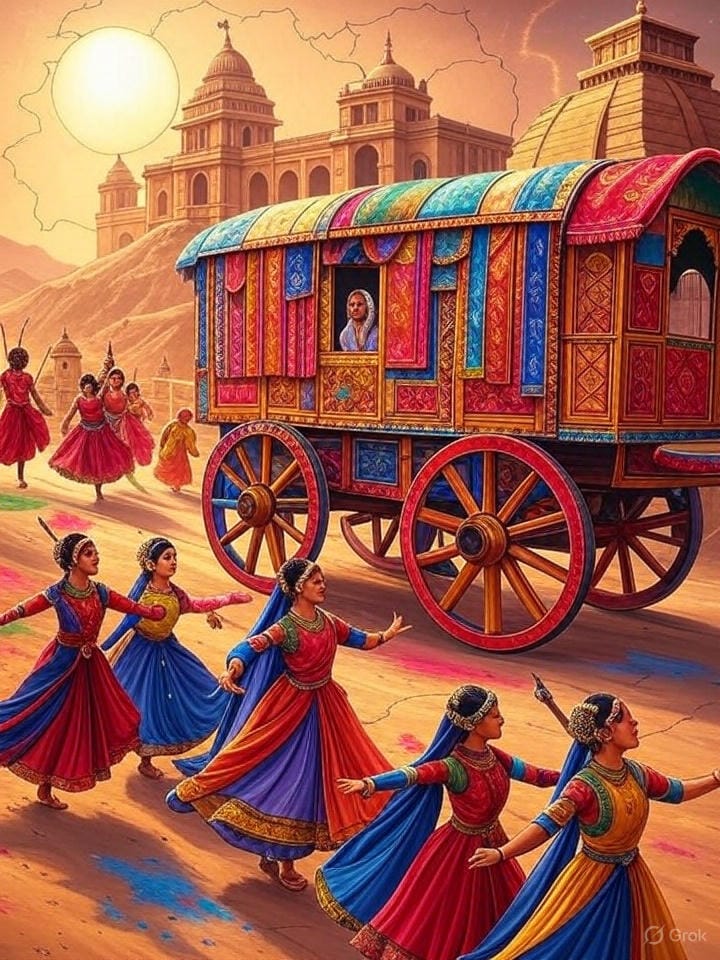
I painted a vivid picture of an Indian caravan—complete with the song Gotilo playing—journeying from Maharashtra, Gujarat, Karnataka, and Kerala to Jebel Ali in the UAE. From there, the caravan would travel to Riyadh, then to Tel Aviv and Haifa port. This journey symbolizes the revival of ancient trade routes and the cultural exchange that once defined these regions. By 2030, I envision this caravan bringing celebration economics to the Gulf, with colorful clothes, festivals, and a textile boom that lets Emirati and Saudi women shine in vibrant attire.
A New Economic Reality
The West’s currency, particularly the dollar, is losing its dominance—a point I’ve been vocal about. In this new reality, the Gulf must align with the geoeconomics of the Indian subcontinent. Historically, India’s customized products were sought after by the world’s elite. Reviving this model—where mass exports cater to global elites—can create a new economic boom. The Gulf, with its strategic position, can become a hub for this exchange, further solidifying its ties with India.
Conclusion: A Vision for the Future
My speech in Dubai on April 13, 2025, was a call to action—a vision for a thousand-year reversal that reconnects Jammu, Jerusalem, and Jeddah. It’s a vision that credits the Prime Minister for his transformative leadership and acknowledges the visionary role of leaders like Crown Prince MBS in the deradicalization process. By reviving ancient trade routes, unearthing pre-Islamic history, and embracing celebration economics, the Gulf and India can forge a future that honors their shared past. As I’ve said before, this reversal isn’t just about history—it’s about creating a vibrant, interconnected, and prosperous tomorrow.