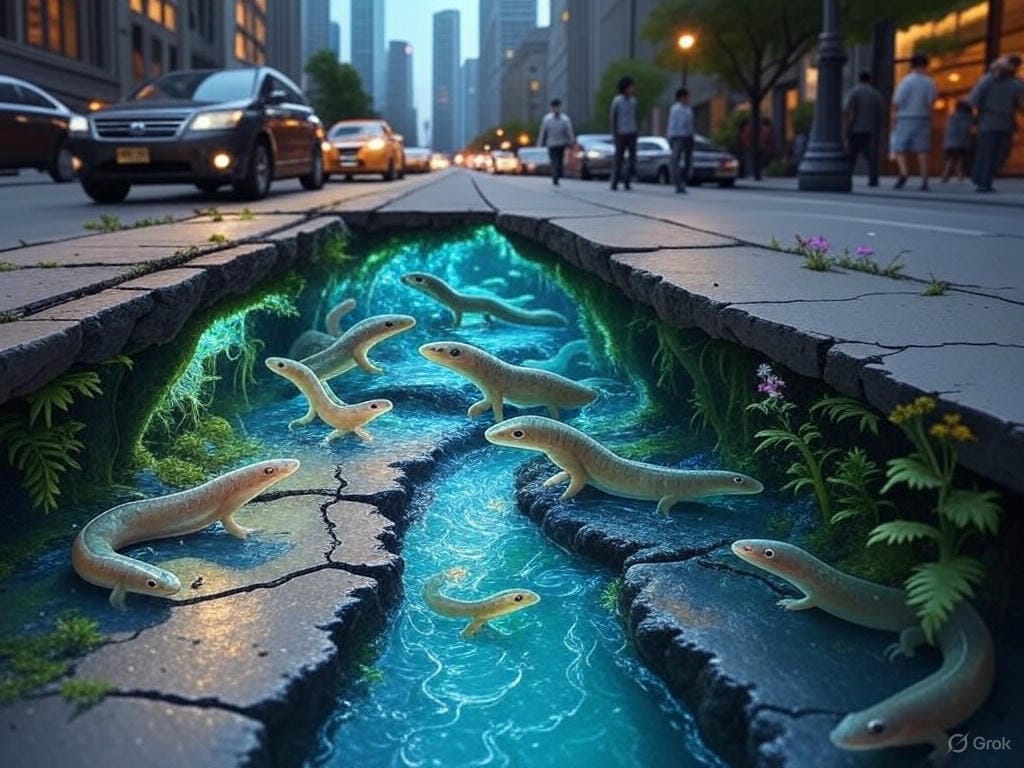
How Buried Waterways Secretly Sustain Ecosystems in Modern Cities?
Beneath the concrete and steel of bustling metropolises lies a forgotten network of rivers, streams, and creeks—vanished from maps but alive in the shadows. Known as “ghost streams,” these waterways, buried during urban expansion, are quietly reshaping urban ecosystems, creating unexpected havens for wildlife and influencing biodiversity in ways scientists are only beginning to understand.
The Lost Rivers Beneath Cities
During the 19th and 20th centuries, cities worldwide entombed their rivers to make way for roads, railways, and buildings. London’s Fleet River, New York’s Tibbetts Brook, and Seattle’s Ravenna Creek are just a few examples, now flowing through tunnels or culverts. Yet these submerged waterways never truly disappeared. Instead, they’ve become cryptic lifelines, seeping through cracked infrastructure and pooling in forgotten spaces, fostering microhabitats for plants, insects, and aquatic species.
Case Study: Seattle’s Thornton Creek
Once buried under parking lots and neighborhoods, Thornton Creek was partially daylighted in the 2000s. Researchers discovered that even its still-buried sections supported microbial communities and invertebrates, which in turn attracted birds and small mammals. The creek’s hidden stretches now act as ecological corridors, linking urban green spaces and enabling species migration.
Unexpected Biodiversity Hotspots
Ghost streams create unique environments where water quality, temperature, and human activity intersect:
- Mosses and Ferns: Thrive in damp, shaded areas near seepage points, even in winter.
- Amphibians: Urban salamanders and frogs use underground channels to avoid predators and extreme temperatures.
- Invertebrates: Rare species of isopods and beetles, adapted to low-light conditions, have been found in culverts.
In Toronto, the buried Garrison Creek has become a refuge for endangered Jefferson salamanders, while London’s subterranean rivers host European eels navigating their way to the Thames.
The Science of Urban Hydroecology
Researchers are using lidar mapping and environmental DNA (eDNA) to track ghost streams’ ecological impacts. A 2023 study in Urban Ecosystems revealed that buried streams in Chicago support 30% more plant diversity than adjacent paved areas. Meanwhile, thermal imaging shows how these waterways regulate microclimates, cooling urban heat islands by up to 4°C in summer.
Dr. Lena Choi, Hydrologist at MIT:
“Ghost streams are accidental experiments in coexistence. They challenge the assumption that urbanization eradicates nature—instead, nature adapts in the margins we ignore.”
Threats and Conservation Efforts
Despite their resilience, ghost streams face risks:
- Pollution: Stormwater runoff carries microplastics and heavy metals into hidden channels.
- Construction: New developments often rupture fragile underground ecosystems.
Cities are now rethinking infrastructure. In Seoul, the Cheonggyecheon Stream—once a buried highway—was resurrected in 2005, sparking a 639% increase in bird species. Similar “daylighting” projects are planned in Glasgow and Los Angeles.
The Future of Urban Planning
Architects and ecologists are collaborating to design “hybrid cities” that integrate buried waterways into green infrastructure. Proposals include:
- Permeable Pavements: Allow water to seep through, recharging ghost streams.
- Culvert Gardens: Vertical planters installed in drainage tunnels to filter pollutants.
- Citizen Science Apps: Tools like GhostWater Tracker let residents report seepage points and wildlife sightings.
Why This Matters
Ghost streams remind us that cities are not static—they are dynamic ecosystems. By acknowledging these hidden networks, we can reimagine urban spaces where nature and infrastructure coexist, fostering resilience in the face of climate change.