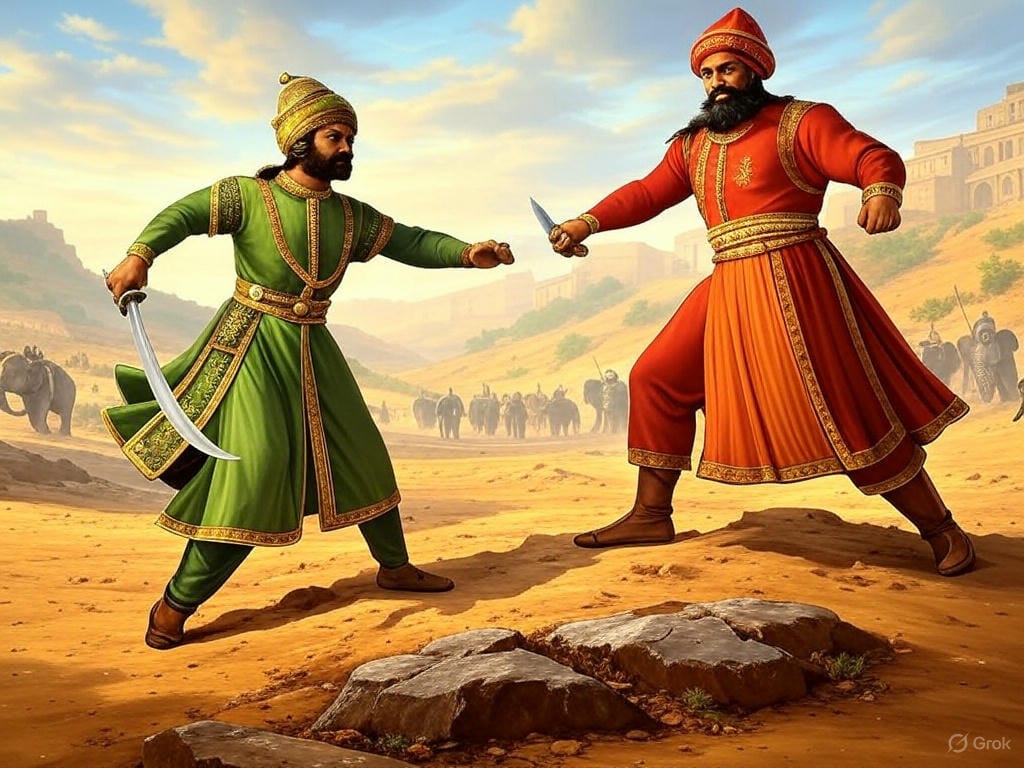
In the annals of conquest, few tales burn as brightly—or as bitterly—as the dance between Babur, the Turco-Mongol invader, and Rana Sanga, the Rajput titan of Mewar. As Babur’s own pen reveals in the Baburnama, and as Rajput scribes whisper through their chronicles, their story is one of fragile promises, clashing ambitions, and a betrayal that ignited a storm across Hindustan. Drawing from these primary voices, let’s unravel the Babur Rana Sanga alliance—a pact that could have redrawn India’s map but instead forged a legacy of rivalry and blood.
A Sweet Proposal from Kabul
In 1525, as Babur sat in Kabul, plotting his descent into Hindustan, a tantalizing offer arrived. The Baburnama recounts Rana Sanga’s envoy, his words dripping with honey: “If the esteemed Padshah approaches near Dilli from that direction, I shall advance towards Agra from this side.” The plan was bold—Babur would strike Ibrahim Lodi from the northwest, while Sanga, the Rajput warlord, would pounce on Agra, splitting the Sultan’s forces like a cracked melon. Victory promised spoils for both: Delhi for Babur, Agra for Sanga.
Yet Rajput sources, like the Mewar ka Sankshipta Itihas (Folio 135(a)-136(a)), flip the tale. They claim Babur initiated the courtship, dispatching envoys to Chittor to woo Sanga against their “common enemy,” Ibrahim Lodi. A Mewar priest writes: “Babur, king of Kabul, sought an ally from the old Rajas… requesting Rana Sanga to cooperate… he would march on Delhi, while the Rana should proceed against Agra.” Sanga, advised by his shrewd general Silahadi, sent a cautious reply, testing Babur’s intent.
Who reached out first? The truth blurs in the fog of pride—Babur’s Baburnama frames Sanga as the suitor, while Rajput lore paints Babur as the desperate petitioner. Both agree on the stakes: a two-pronged assault to topple Lodi’s throne.
The Pact Unravels at Panipat
By April 1526, Babur’s gamble paid off. At Panipat, his 12,000 men—or far more, as modern scholars argue—crushed Ibrahim Lodi’s vast army, seizing Delhi and Agra in a thunderous sweep. But where was Sanga? The Baburnama seethes with scorn: “Sangā showed no sign of moving.” Instead, as Babur consolidated his grip, Sanga laid siege to Kandar, a fort held by Hasan, son of Makan, who’d begged Babur for aid but surrendered when none came. Babur fumes at this “betrayal,” accusing Sanga of breaking their deal.
Rajput chronicles offer a counterpoint. They admit Sanga agreed to strike Agra but argue he held back, swayed by his chiefs. Why? Sanga saw Babur not as a partner but as a plunderer in Timur’s mold—a storm to weather, not join. “To feed milk to a cobra,” his nobles warned, fearing Babur’s ambitions stretched beyond Punjab’s loot. The Mewar ka Sankshipta Itihas is blunt: Sanga chose neutrality, watching victory’s winds before committing.
A Conqueror’s Trust, A Raja’s Caution
Was Sanga’s hesitation treachery or pragmatism? Babur faced a foe—Ibrahim Lodi—whose wealth and manpower dwarfed his own. Seeking Sanga, Hindustan’s mightiest Rajput, made sense; an ally could tip the scales. Yet Sanga had no such urgency. Babur was a distant thunderclap, his strength unproven until Panipat. Rajput tradition favored the tiger’s patience—lurking in the grass, not leaping at shadows. The Baburnama lacks its usual clarity here; Babur meticulously logs pacts with Alam Khan Lodi and Daulat Khan Lodi, but Sanga’s deal is a vague whisper. Did Babur, a master of embellishment (his “12,000 men” claim debunked), stretch the truth?
The Rajput version holds weight—both narratives align on the plan: Babur hits Delhi, Sanga takes Agra. Yet Sanga’s pause wasn’t refusal; it was calculation. When Babur didn’t just raid but ruled Punjab, Sanga saw a rival, not a raider. His chiefs urged caution, and feudal loyalty bound him to Mewar’s interests over a foreign king’s dreams.
From Ally to Enemy: The Kandahar Spark
Babur might have shrugged off Sanga’s inaction—war spares little time for grudges—but the Rana’s next moves lit a fuse. Post-Panipat, Sanga seized Kandar, ousted Hasan, and claimed 200 towns once under Lodi’s sway, displacing Muslim families. To Babur, a devout Muslim, this wasn’t just ambition—it was sacrilege. He laments in the Baburnama: “Infidel standards now flew over 200 towns in the lands of Islam; mosques and shrines lay in ruin; the wives and children of the Faithful were captured.”
Then came the alliance that sealed their fates. Mahmud Lodi, Ibrahim’s surviving kin, fled to Chittor, where Sanga sheltered him, crowning him Sultan of Hindustan. Hasan Khan Mewati, a Muslim lord, joined them, forging a Rajput-Afghan pact to expel Babur—the “foreign usurper.” Babur countered swiftly, securing Bayana with Mahdi Khwaja and bracing for war. What began as a tactical alliance crumbled into a clash of crowns.
Faith, Power, and a Gathering Tempest
Sanga’s shift wasn’t mere opportunism—it was ideology. As Mewar’s guardian, he saw himself as Hinduism’s shield, duty-bound to resist a Muslim invader. Babur, champion of Islam, aimed to cement his rule by rallying India’s Muslims, their faith his anchor. The Baburnama drips with righteous fury at Sanga’s “infidel” gains, while Rajput scribes laud Sanga’s stand against a new Timurid yoke.
Their rift exploded at Khanwa in 1527, where Babur’s cannons and Sanga’s valor collided. Babur won, but Sanga’s defiance etched a legend. The geopolitical history of India 1526 hinges on this moment—a broken pact that birthed an empire and a resistance.
The Conqueror’s Pen and History’s Shadow
As Babur’s biographer, I weigh his words against Rajput echoes. The Baburnama is a conqueror’s lens—vivid, yet skewed. Sanga’s envoy to Kabul? Uncorroborated by Hindu or Muslim peers. The Rajput tale of Babur’s outreach? Plausible, given his need for allies. Truth lies in the overlap: a deal was struck, then shattered by mistrust. Sanga’s neutrality cost him Agra; Babur’s wrath cost Sanga his dreams.